Before the Screenshot: A Short History of the Quotation
The history of the quotation shows how excerpts lose their setting. Trace a passage to its source and decide what its words can fairly support.
The most common mistake with a quotation is assuming that accurate words make a fair account of the whole exchange. That shortcut can lead readers to attribute a position to someone who was quoting an opponent, answering a narrow question or correcting an earlier point. The history of the quotation helps explain how a passage can travel intact while its purpose gets left behind.
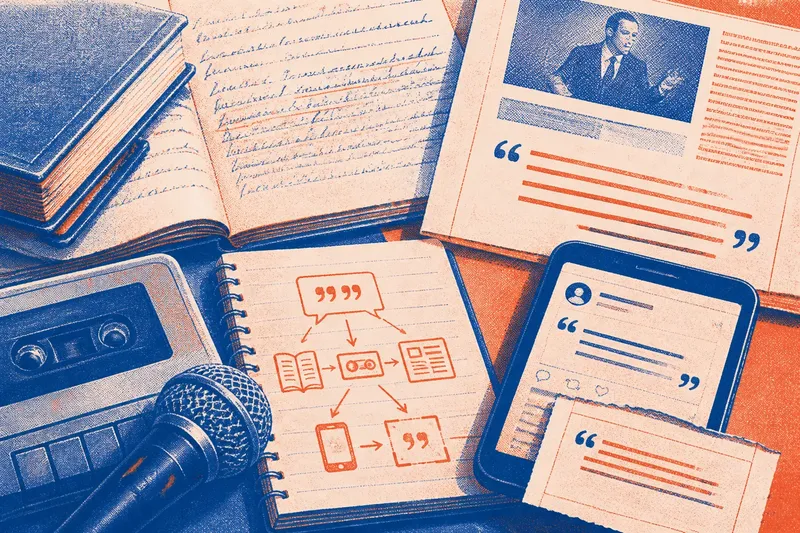
There is no single path from speech to print to screen, and copying practices have varied across communities and periods. A safer way to think about the history is to ask what each form preserves, what it makes easier to lose, and how that changes the evidence available to a reader.
Remembered speech carried the occasion as well as the words
In conversations and oral retellings, a listener could hear tone, pauses and the question that prompted a reply. Later retellings might preserve a memorable phrase while changing its exact wording or leaving out the exchange around it. The degree of accuracy depended on the speaker, the listener and the purpose of the retelling, so it is too broad to treat all oral quotation as either exact or unreliable.
That distinction still matters when a present-day account quotes a conversation from memory. If the writer says “approximately” or presents a paraphrase, the wording should not be treated as a verbatim record. If the claim depends on exact phrasing, look for a contemporaneous note, recording or other source that can be checked.
Manuscript excerpts preserved words but changed their neighbours
Hand-copied texts could preserve passages beyond the moment of speech, but copying and compiling involved choices. A passage might be selected, grouped by topic or copied without the pages that came before and after it. Those practices differed among texts and settings; they do not support a simple claim that every manuscript was shortened or reshaped in the same way.
The practical consequence is that a passage can be faithfully copied yet still be an incomplete guide to its author’s position. When a quotation comes from an anthology or a collection of sayings, follow its attribution to the underlying work if possible. Then check whether the original passage is explaining, endorsing or disputing the quoted words.
Print made excerpts easier to circulate and frame
Printed pages enabled copies to circulate, while editors and publishers still selected passages, arranged them and supplied headings or introductions. A quotation placed beside a headline or another passage can acquire an emphasis that is not obvious from its wording alone. These effects depend on the particular publication; print does not automatically make a quotation more accurate or less fair.
Quotation marks identify words presented as borrowed, but they do not establish who first said them or whether the surrounding selection is representative. An ellipsis indicates an omission, yet a reader still needs to consider whether the omitted material changes the point.
Imagine a news editor selecting the sentence “the proposal may help in some circumstances” from a longer report. The report also says that the conditions are limited. If the headline drops that qualification, readers may infer broader support than the passage provides. Comparing the headline with the full report makes the difference visible: the sentence remains accurate, but its apparent reach narrows when the omitted condition is restored.
Recordings preserved delivery but not the whole event
Audio and video can preserve a speaker’s voice, pauses and emphasis. A broadcast clip, however, remains a selected segment. It may omit the question, an earlier explanation or a correction made later in the conversation. The recording is evidence of what can be heard in that segment; it does not, on its own, establish what happened outside the frame.
If an argument depends on tone, interruption or hesitation, a transcript alone may not answer it. If the point depends on the speaker’s broader position, seek the full interview or recording and check the surrounding exchange. These are different questions, so the useful source may differ too.
Digital fragments make the source boundary easy to miss
A sentence can move from an article to a social post, then into a screenshot or an image. During those transfers, a link, date, byline or correction may disappear. A screenshot can look self-contained because its edges are visible, but the crop is a selection, not proof that the displayed words are the entire source.
For a quotation circulating online, search a distinctive phrase and follow results back to the document, transcript or recording. Check the source’s date and author, then compare the shared version with the original. If the trail stops at a repost, say that the source remains unverified rather than presenting the wording as settled.
Use the source trail to decide what the quotation supports
Checking a quotation is not only a hunt for matching words. It is a way to establish what kind of evidence you have and what conclusion it can support. Use the observations below to choose the next action; if a source is missing or ambiguous, narrow the claim rather than filling the gap with an assumption.
- Observation: the post names only the person who shared the quotation. If it does not identify the original speaker or author, then search the wording and ask for the underlying source; if no source appears, describe the attribution as unverified.
- Observation: the quotation links to a source document. If the link opens the original work, then record its title and inspect the surrounding passage; if it leads to a repost, continue tracing before relying on the attribution.
- Observation: the text is described as a paraphrase or remembered conversation. If exact wording is not documented, then report it as a paraphrase; if the argument requires verbatim words, seek a contemporaneous record or omit the exact quotation.
- Observation: an ellipsis or crop removes material. If the missing words include a condition, question or reply, then restore that context when describing the claim; if they do not change the point, note the omission without implying that it does.
- Observation: the quoted words appear inside a larger argument. If the surrounding passage identifies them as an opposing view or a claim being challenged, then do not attribute them as the author’s own position; if the passage endorses them, describe that support with its stated limits.
- Observation: a recording and transcript are both available. If delivery, interruptions or uncertainty matter, then check the recording as well; if only the wording matters and the transcript identifies its source, use it while noting any limits.
- Observation: the source trail ends at a screenshot or repeated reposts. If the original cannot be located, then label the quotation unverified or leave it out; if an original later becomes available, compare the wording and context before using it.
Say you receive a screenshot that attributes “the proposal may help in some circumstances” to a named report, with no link. First, search that exact phrase and locate the report’s own page. Next, compare the screenshot with the report and find the paragraph stating that the proposed benefit depends on limited conditions. Then check whether the report presents the phrase as its conclusion or as a view under discussion. The resulting decision is to quote the sentence only with its condition attached; if the report cannot be found, the attribution remains unverified and the sentence should not carry the argument.
What should you check before using a quotation?
Does an accurate quotation always express the author’s view?
No. The author may be quoting an opposing position, describing a claim or rejecting the words that follow. Read the nearby passage to identify who holds the view.
What should you do with a cropped quotation?
Find the source and compare the crop with the complete passage or recording. Restore any omitted question, qualification, reply or correction that changes how the words should be understood.
Can a transcript replace a recording?
It can help verify wording, but it may not convey tone, interruptions or hesitation. Consult the recording when those features affect the claim.
What if you cannot find the original source?
State that the quotation is unverified, or leave it out if your point depends on exact wording. Repetition by other accounts does not supply the missing source.
Trace the words and state the limit
The history of the quotation is not a straight march from unreliable memory to perfect records. Each medium preserves some features and leaves others open to loss or selection. A useful check is therefore specific: identify the source, inspect the passage or exchange, and state only what that material supports.
When you use a quotation, tell readers if it comes from a transcript, a remembered conversation or an excerpt, and keep relevant limits attached to it. Think of the source boundary like the lid on a storage tin: it shows where the contents stop, but you still need the label to know what you are handling.