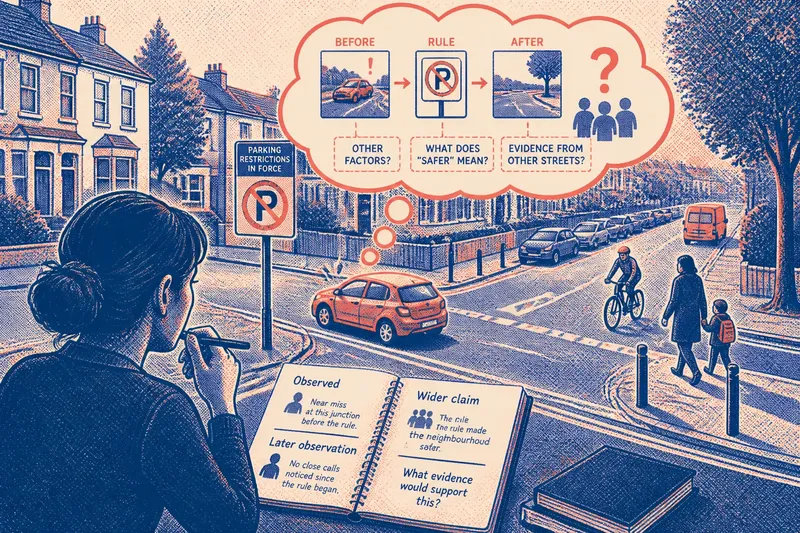
What a Claim Actually Says
What a claim actually says can differ from the conclusion it invites. Separate the literal statement from its implications before deciding what follows.
The common mistake is treating an implied conclusion as though the sentence stated it outright. With a claim, that can turn a narrow observation into a sweeping belief, or make a cautious statement sound like a promise. To judge what a claim actually says, begin with its exact wording and sort your situation before deciding what follows.
Start with the sentence, not the impression
A claim is a statement that presents something as true or likely. Its literal content is what the words commit the speaker to. An implication is a further idea a reader may reasonably infer, but the wording does not necessarily establish it.
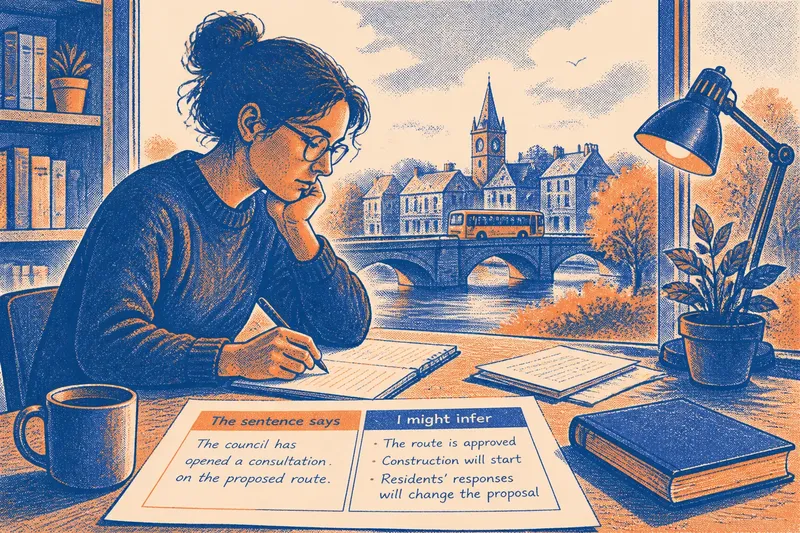
Take the sentence, “The council has opened a consultation on the proposed route.” Literally, it says that a consultation has begun and identifies its subject. It does not say that the route has been approved, that construction will start, or that residents’ responses will change the proposal.
Underline the main verb and identify its subject. Then ask what the sentence says happened, is happening, or may happen. Treat added ideas as separate claims, even when they feel like the natural next step.
Choose the situation that matches your question
The right reading depends on what you are trying to decide. Use the situation closest to yours rather than making one sentence answer every possible question.
You need to know what was directly asserted
Keep to the literal content. Restate the sentence in plain words without adding motives, causes or consequences. If the wording says a service “is available in selected areas”, the safe restatement is that availability is limited to some areas; it does not mean the service is available everywhere.
Preserve qualifiers such as “some”, “may”, “reported” and “in selected areas”. They are part of the claim, not decorative hedges to discard. Removing one can materially change what a reader would think the sentence promises.
You need to know what the wording suggests
Name the inference separately and check what connects it to the literal statement. A sentence can invite a conclusion through a word’s tone, a contrast with an earlier event, or an omitted condition. That invitation matters, but it is not the same as an explicit assertion.
For instance, “The new timetable follows a rise in complaints” places two facts beside each other. A reader may infer that complaints caused the timetable change. Unless the wording or supporting material states that link, causation remains an inference.
You need to decide whether to act
Do not let an implied conclusion carry a practical decision on its own. Identify the action you are considering, then list the specific claim that would need to be true for that action to make sense. If the sentence does not answer that question, seek a direct statement or relevant detail.
This matters especially when the wording concerns eligibility, deadlines, access or a change to a service. A broad announcement may describe a general intention while leaving individual circumstances unresolved. For decisions with legal, financial, health or safety consequences, check the relevant official information or ask a qualified professional.
Separate the statement from its wider conclusion
Use a two-column note. In the first column, write “The sentence says” and record only its literal content. In the second, write “I might infer” and add any conclusion that goes beyond those words. The gap between the columns shows what still needs support.
Say you read, “The library has extended evening opening at its central branch.” The first column says that evening opening has been extended at that branch. You might infer that every branch now closes later, or that the change is permanent, but neither follows from the sentence alone. Check the relevant branch’s published hours and the stated dates before planning a visit.
This simple separation works like sorting keys from loose change: the items may sit together, but they are not interchangeable. Keep the original wording intact, especially if you are passing the claim on. A paraphrase should not quietly turn “can” into “will”, “one location” into “all locations”, or “after” into “because of”.
Check the boundaries built into the words
Several small features often define a claim’s reach:
- Scope: Who or what is covered? Look for words such as “all”, “some”, “participants” or a named location.
- Time: Is the statement about the past, present or future? A current condition does not by itself establish what will happen later.
- Certainty: Does it say “is”, “may”, “is expected to” or “could”? These expressions make different commitments.
- Comparison: What is being compared, and on what basis? “Higher” needs a reference point to tell you how to interpret it.
- Cause: Does the sentence actually say one thing produced another, or merely mention them together?
- Conditions: Are there exceptions, eligibility rules or circumstances that limit the statement?
These are not clues to dismiss a claim. They help define the exact proposition that could be checked. A precise, limited claim may be meaningful even when it leaves wider questions unanswered.
What does a strong word commit the speaker to?
Words such as “always”, “never”, “proves” and “only” make broad commitments. Ask whether the sentence supports that full reach, rather than quietly replacing the strong word with a softer one. If it does not, report the narrower wording instead of repeating the stronger conclusion.
Does a detail imply a cause?
Not by itself. A detail may establish that two things occurred or were observed, while leaving the reason for their connection unknown. Look for an explicit causal claim and the information offered to support it before treating the inference as established.
Can a careful claim still leave a misleading impression?
Yes. Each sentence can be literally accurate while its placement or emphasis encourages a broader conclusion. Keep the literal reading and the likely impression distinct, then explain the difference without declaring the wording false unless you can identify what is inaccurate.
How should you repeat a claim to someone else?
Preserve its subject, scope, time and certainty. Mark your own inference with language such as “this may suggest” rather than presenting it as part of the original statement. If the distinction matters to the decision, include both the exact claim and the unresolved point.
Use the narrow reading as your starting point
When a statement feels larger than its wording, write down the literal claim before reacting to its implications. That gives you a clear basis for checking what is asserted, what is suggested and what remains undecided. The most reliable account of what a claim actually says is neither the most suspicious reading nor the most generous one: it is the one that preserves the sentence’s full wording without adding commitments it never made.