What One Example Can—and Cannot—Prove
Learn what one example can prove, how to spot the leap from a vivid case to a broad claim, and what evidence would help settle the wider question.
The common mistake with a striking example is to treat its vividness as evidence about everyone else. The cost is a broad conclusion built on a narrow account. To judge what one example can prove, look at what was observed, what the claim adds, and what further evidence could connect the two.
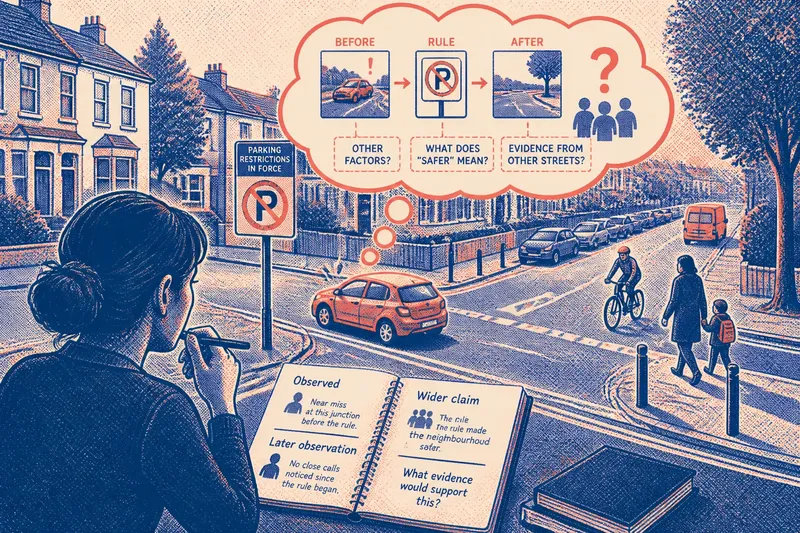
Say you read a neighbourhood post claiming that a new parking rule has made local streets safer. The writer describes a near miss at one junction before the rule, then says they have noticed no close calls there since it took effect. The account may be sincere and useful. It does not, by itself, show that the rule made the neighbourhood safer.
Keep the post’s value in view without asking it to do too much. A single account can bring a possible problem or change to attention. The next question is what would turn that lead into a sound claim about a broader pattern.
Distinguish a reported event from a claim about a pattern
The post makes at least two claims. One concerns a particular junction: a near miss occurred before the rule, and the writer has not noticed one since. The other concerns the rule’s effect across the neighbourhood. That wider claim adds a cause, a pattern and a larger area.
Those additions require support. A detailed account may help establish what one person saw at one junction. It cannot show how often similar events occur elsewhere, whether incidents changed overall, or what caused any change. A single case can illustrate a possibility in the circumstances described; it cannot establish how common that possibility is.
Make the distinction explicit in your notes. Record the account as “one resident reports no close calls noticed at this junction since the rule began”. Keep “the rule made local streets safer” as a separate claim to assess. This prevents a report about an individual observation from quietly becoming a neighbourhood-wide finding.
Follow the missing links in the story
A before-and-after account has a natural shape: danger, a rule change, then apparent calm. That sequence can make the rule seem like the cause. But the timing alone does not rule out other explanations.
In the parking case, the writer may have changed their route, travelled at different times, or encountered different traffic conditions. Roadworks or diverted vehicles might also affect what they noticed. These are possibilities to check, not reasons to assume the account is wrong.
Ask what “safer” means in the post. Fewer close calls noticed by one resident is not the same measure as fewer recorded collisions or safer conditions for pedestrians. If the outcome is not clear, the claim cannot be compared reliably with evidence that measures something else.
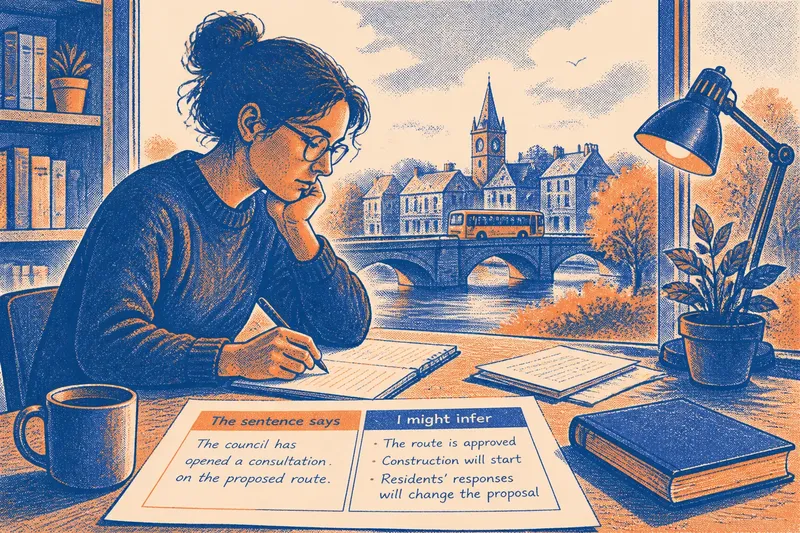
One useful habit is to mark each sentence as observation, interpretation or conclusion. The observation is what the writer reports seeing. The interpretation connects the observation to the rule. The conclusion extends that interpretation to other people or places. The further the claim travels, the more links need support.
Check what would support a wider safety claim
If the question is whether safety changed across the neighbourhood, look for information that covers more than one junction and one person’s memory. Relevant material might include incident records or consistent observations from several locations. Check what each source counts, which roads it covers and whether its time periods are comparable.
A claim that the rule caused a change needs more than a difference before and after. Ask what else changed during that period, such as construction or diverted traffic. A comparison with similar streets not affected by the rule could help assess whether some broader change offers another explanation. The right evidence depends on the exact claim.
When a source or record is missing from a post, separate three possibilities: the information may not have been collected, it may exist but not be linked, or it may be available but incomplete. An absent link does not show that no evidence exists. An official record, in turn, does not necessarily cover every relevant event.
For a quick assessment, use this check. Each observation leads to a decision, with an alternative action if the answer is unclear:
- Check whether the post names a place; if it identifies one junction, treat the account as local, but if the location is unclear, seek the original post or ask what area it means.
- Check whether the writer reports direct observation; if they describe what they personally noticed, attribute the account to them, but if they repeat hearsay, look for the original source.
- Check whether “close call” or “safer” is defined; if the terms are specific, compare like with like, but if they are vague, avoid treating them as measured outcomes.
- Check whether the account covers other streets; if it does not, keep the conclusion to the named junction, but if it claims a neighbourhood pattern, look for evidence from additional locations.
- Check whether the account compares similar times and conditions; if it does, consider the comparison cautiously, but if it does not, note that traffic, routes or roadworks may differ.
- Check whether the claimed change began after the rule; if timing is documented, treat it as one relevant clue, but if timing is uncertain, verify when the rule and observation period began.
- Check whether another source records the same outcome; if records are available, inspect their coverage and definitions, but if none can be located, describe the wider effect as unresolved rather than settled.
Imagine a reader has only the invented post above, with no linked records. They write down the starting information: one reported near miss before the rule, one resident’s later observation at the same junction, and no account of other streets or comparable conditions. They then separate the reported observation from the causal claim and search for incident records covering the neighbourhood. If none are available, their resulting judgement is that the post illustrates one resident’s experience, while the rule’s wider effect remains unknown. That answer preserves the account without treating missing evidence as proof either way.
What can one example establish?
Can one example show that an event is possible?
It can support that conclusion when the account is credible and the relevant circumstances are clear. It does not show how often the event happens or whether it occurs in other settings.
Does a before-and-after story show that a change caused the result?
No. The order of events may be relevant, but other changes could explain what followed. A causal claim needs evidence that addresses plausible alternatives.
Does a trustworthy source make an example representative?
No. Trust can affect how much weight to give a person’s account of their own experience. It does not make that experience representative of a neighbourhood or establish a cause the person did not observe.
How should I share a compelling example?
Name it as one reported case and say what it illustrates. If you also mention a broader claim, make clear what additional evidence would be needed to assess it.
Keep the conclusion within the evidence
For the parking post, the strongest supported wording is that one resident reports a near miss before the rule and says they have not noticed close calls at that junction since. That is a useful account of one person’s experience. It does not establish that the rule improved safety at that junction or across the neighbourhood.
Look for records or observations that cover the larger claim, then check that they concern the same outcome and area. If that evidence is unavailable, say the wider effect remains unclear. The phrase “one example does not prove a general pattern” is useful only when you also name what the example does show.
Keep that boundary when you pass the story on: preserve its location, source and limits. A vivid case can point towards a question worth answering; it should not answer a broader question on behalf of people and places it never describes.